Workflow automation08 / 09
Automations
The follow-up nobody owned, owned by a system.
What we doARK
/ 09 · Be built around
Now, in India · IST
An enquiry arrives.
Workflow automation for the work between the work
Every company runs on work nobody is hired to do: the enquiry that lands at two in the morning, the reply that belongs on a deal, the reminder due at four. We build the systems that route each one to its place, draft what comes next and keep the record, every time, at any hour.
01 · Who it is for
For the company where the follow-up has no owner.
If your enquiries arrive at every hour and through half a dozen doors, and each one waits for whoever happens to notice it, the follow-up has no owner. That is the company we build for. Each arrival is routed to its place, drafted, timed or recorded by a system, and written into a log you can read.
Sun 02:14:06 Two in the morning, on a Sunday. The enquiry lands in the pipeline the moment it is sent, and whoever assigns new leads is told before anyone is awake to read it.
Mon 09:41:12 A client answers from their own inbox. The mail is threaded onto its deal, so whoever opens the deal next reads the whole conversation.
Mon 13:05:30 A customer taps an item on WhatsApp. The tap is answered without calling a model; the price and the running total come from tested code.
Mon 16:00:14 Set last week with a voice note. It goes out at its minute, and nothing on the way asks a model for anything.
Mon 16:20:41 The AI drafts the reply from the thread, and it stops at the gate. Nothing the AI writes leaves a rep's mailbox until a person has read it and tapped send.
Five arrivals, five routes, one log. Nobody had to remember any of it.
- Sun 02:14:06An enquiry, from the websiteThe pipelineOn arrival
- Mon 09:41:12A client's emailIts dealWithin 3 minutes
- Mon 13:05:30A WhatsApp order, by a tapThe order, pricedIn about 270 ms
- Mon 16:00:14A reminder, due at 16:00The person, at the minuteWithin 15 seconds
- Mon 16:20:41The reply to 09:41, draftedThe clientAfter a tap
An illustration: the times and the messages are examples. Every route is a mechanism running in a system ARK built: Intellreach, ARK Assistant and a WhatsApp ordering agent.
02 · What gets automated
The work between the work.
It is the work that sits between the jobs people are hired for: an enquiry reaching the person who should answer it, a quote assembled from the record, a reminder arriving at the minute, a record kept without anyone typing it twice. Four kinds of work, and none of them should depend on someone remembering.
From the website, a consultant's portal, a visiting card, a project listing, a rep's own mailbox: each one lands in one pipeline, the people who decide who takes it are told at once, and nobody has to forward anything.
Written from the deal's own thread, with the arithmetic checked in code before anyone can send it. The words come from the AI; the totals never do.
At the minute asked, on a schedule no model can hold up. The day's list arrives at eight; code decides what is on it.
Every email threaded, every stage move audited, every action written down as it happens, so the record is the work itself, not a job for Friday evening.
Where a step needs judgement as well as a route, that is enterprise AI. Where the system itself does not exist yet, that is custom software.
03 · Running on their own
Three systems ARK built run every day without being asked. Here is when, on your clock, right now.
These three minutes, in India
15sARK Assistant claims every reminder that has come due
3minIntellreach reads every rep's mailbox and threads each client's mail onto its deal
08:00ARK Assistant sends you your day, in two messages
01 Intellreach
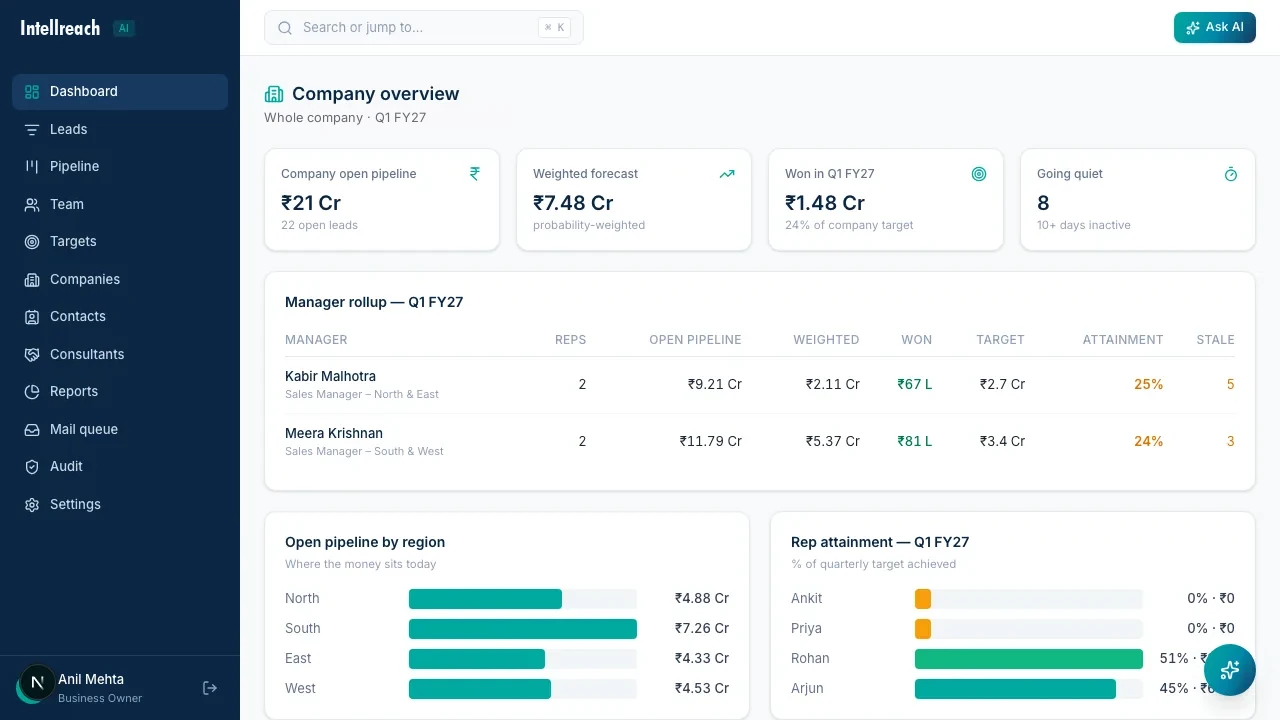
Intellreach routes seven channels into one pipeline.
Seven doors, from the website's form and a consultant portal to visiting cards read at an exhibition and a rep's own mail, open onto one pipeline, and every email is threaded onto its deal, both ways. In production since September 2026. Its morning digest at eight is built, not yet in production.
02 ARK Assistant
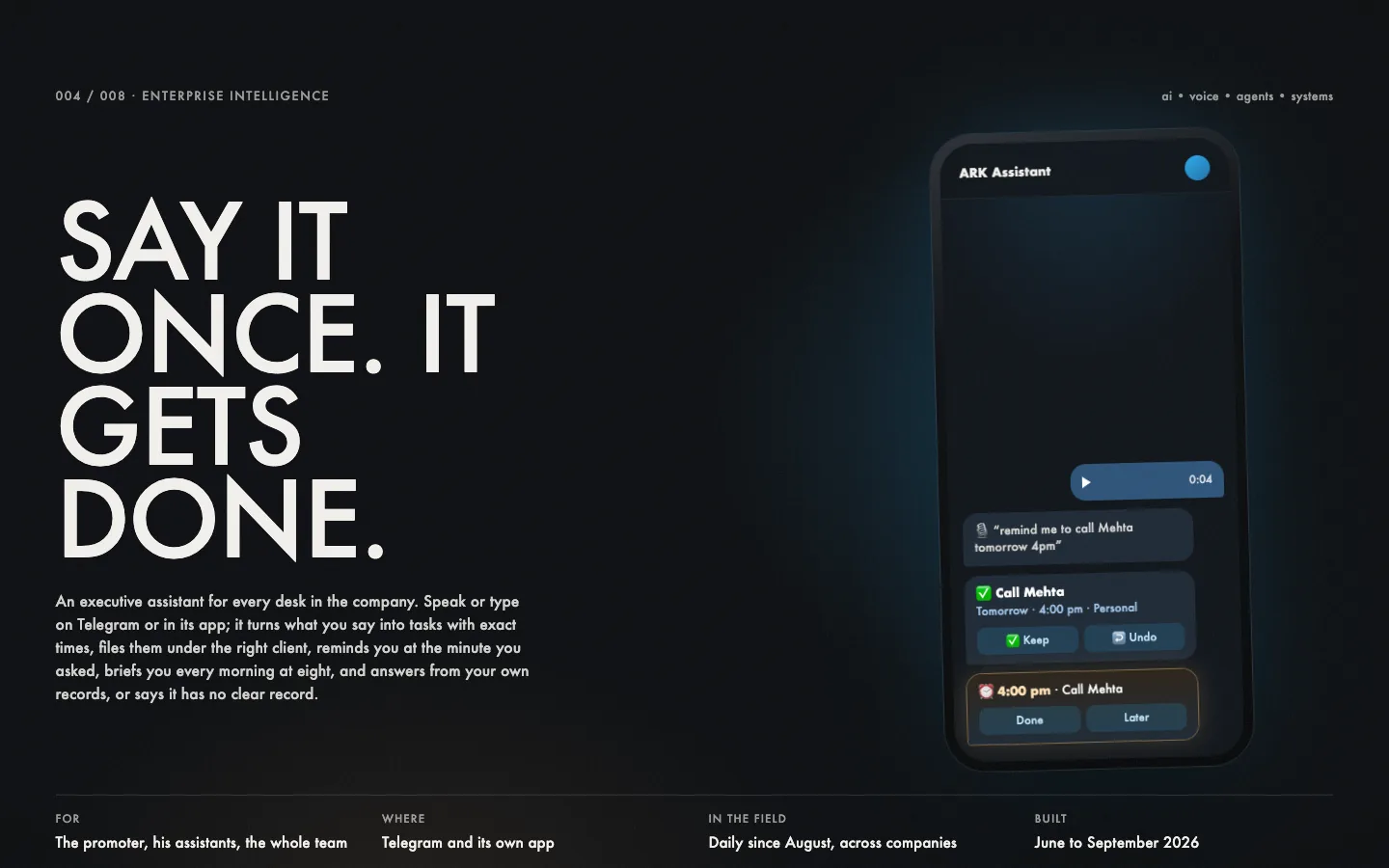
ARK Assistant: at the minute asked, every time.
Say it once on Telegram, typed or as a voice note, and it becomes a task with an exact time. A clock with no AI in it claims what has come due and sends it; your day arrives at eight. In five weeks of daily use: 850 reminders, none missed.
03 WhatsApp orders
A WhatsApp ordering agent, live for a restaurant.
Customers order by chatting, the way they already do. The AI reads what they meant and how to reply; tested code decides every price, every total and every allergy escalation, and checks each reply against the menu's numbers before it is sent.
One order, measured12 turns, 5 model calls
Each line is the system's own schedule, kept on your clock; where in it each run falls is an illustration. The ordering agent's figures are its own measurements.
04 · Code or tools
Code where it must never miss. Tools where they are enough.
Not every automation needs engineers. Where a missed step costs an hour, an off-the-shelf tool such as Zapier, Make or n8n is enough, and we use it and say so. Where a missed step costs a customer, we build it in code, test it, and keep the AI away from anything it could get wrong.
Code, where a miss costs a customer
automated tests on one reminder path alone; about 2,480 in all, run on every change
- Reminders claimed, sent and closed by code alone.
- Every price, total and allergy escalation in tested code, and every reply checked against the menu before it is sent.
- Every number in the pipeline computed in code. The AI writes the words; it never does the arithmetic.
Tools, where they are enough
Zapier, Make or n8n
- A form into a sheet
- A sheet into a weekly email
- A file from one folder to another
05 · The record
The routed log: how you see that it ran.
Every action writes its own line as it happens: when it came in, where it went, what it left on the record and who had to approve it. Most need no one. A reply the AI drafted for a client waits for a person's tap; an order's total is checked against the menu, in code, before it goes.
- Sun 02:14:06An enquiry, from the website The pipelineA new lead, waiting to be assigned; a bell and an email to whoever assigns itNo one had to
- Mon 09:41:12A client's email Its dealThe mail on its deal's thread, the client's attachments savedNo one had to
- Mon 13:05:30A WhatsApp order, by a tap The order, pricedThe item, its price and the running total, from tested codeCode, against the menu
- Mon 16:00:14A reminder, due at 16:00 The person, at the minuteSent on Telegram and in the app, then closedNo one had to
- Mon 16:20:41The reply to 09:41, drafted The clientThe draft, held on the deal until a person sends itThe rep, with a tap
The same five lines as the log above, kept. An illustration: the times and the messages are examples.
06 · The proof
The work that proves it
Two of the systems above, each with its own case study: how it was built, and what it does without being asked.
07 · Questions
What leaders ask before they automate.
- What do you automate?
- The work between the work: the enquiry that has to reach the right person in seconds, the quote that has to be drafted from the record, the reminder that has to arrive at the minute, the record that has to be kept whether anyone remembers or not. Intellreach takes enquiries from seven channels into one pipeline and threads every email onto its deal, both ways.
- Do you use Zapier, Make or n8n, or build it in code?
- Both, by the job. Where a miss would cost you a customer, we build it in code and test it: ARK Assistant's reminders run on a clock with no AI in it, and in five weeks of daily use not one was missed. Where an off-the-shelf tool is enough, we use it and say so.
- How do we know an automation actually ran?
- You read it. Every action is recorded as it happens: what came in, where it went, when. Nothing the AI drafts for a client is sent until a person has read it and tapped send, so the system never speaks in your name without you.
- How do you price automations?
- By the system, not by the hour. The gap analysis names what would close each leak and what it would return; the brief fixes the scope and the price before we build; and we don't take on work we can't own end to end.
The routed logThe next line
Mon 16:20:41The reply to 09:41, draftedThe clientAfter a tap
In → Routed toYour enquiry ARK
Tell us where the work waits for someone to remember it. We'll route it, draft it, time it and keep the record, and you'll read the log. Not sure where it waits? That is what a gap analysis finds. Automations is one of nine services built to work as one system.
Software built around you09 / 09
Custom software
The system that doesn't exist yet, built around how the work actually flows.
What we doARK
Keep scrolling
to the next service