ARK

/ 09 · Be built around

Enterprise gap analysis: where the work leaks, and what would close it

We don't hand you a maturity score. We sit with the people who do the work, draw how it really moves from the first enquiry to the last invoice, find every place it leaks, and name the AI, automation or software that closes each one, in the order the returns come.

Enterprise gap analysis06 / 09

Gap analysis

Where the work leaks, and the system that closes it.

What we doARK

How the work moves, on paper.
  1. Enquiry
  2. Quote
  3. Order
  4. Delivery
  5. Invoice
  6. Follow-up

01 · The leaks

For the company that knows the work leaks, and wants to know where.

You have a company, and it has gaps: somewhere between the first enquiry and the last invoice, the work slips. This is for the leadership that can feel it and wants to know exactly where, before a rupee is spent on AI. Five leaks of the kind we look for first.

02 · The race

If you don't close them, a competitor will: with AI, with workflows, with systems.

One enquiry reaches you and a competitor at the same moment.

03 · The close

Each gap, closed by the system that fits it.

AI where the work is reading and writing. Automation where it repeats. Software where it needs one record. Then the enquiry runs through, from the first reply to the follow-up.

  1. The enquiry that waited over a weekend.

  2. The quote built in Excel.

  3. The figure typed three times.

  4. The report made by hand on Sunday night.

  5. The follow-up nobody owned.

An illustration: the flow of a company that sells, makes and delivers. The leaks are the kinds we look for; no figure is implied.

The definition

What an enterprise gap analysis is

An enterprise gap analysis is a map of how your company's work actually moves, from the first enquiry to the quote, the order, the delivery and the invoice, drawn from the people who do it. On that map we mark every place the work leaks, and against each leak we name what would close it, in the order the returns come.

It is not a compliance audit and it is not a survey. It is read off the floor: the inboxes, the spreadsheets, the handovers between desks, the places a customer waits. And it is where the rest of the work begins, because it decides whether a gap needs enterprise AI, an automation or custom software: the first of the nine services we build as one system.
The method

How it runs

Three moves: we sit with the people who do the work, we draw the flow as it really runs, and we rank every gap by what it costs you. Nothing is taken from a questionnaire; everything on the map was watched or said by the person whose desk it crosses.

  1. 01

    We sit with the people.

    The salesperson, the estimator, the dispatcher, the accountant, the owner. We watch the enquiry arrive, the quote get built and the order change hands, and we keep what each of them says in their own words.

  2. 02

    We draw the flow.

    One line from the first enquiry to the follow-up, every desk and every handover on it, as the work really runs, not as the process document says it should.

  3. 03

    We rank the gaps.

    Every place the line breaks, ranked by what it costs you: the customer who went elsewhere, the hours spent typing a figure again, the days a decision waits. The worst leak first.

The deliverable

What you get

Three things, specified closely enough to build: the map of your flow as it is; the gaps, ranked by what they cost you; and for each gap the system that would close it, whether AI, an automation or software, with what it needs to run. A build list, not a slide about maturity.

The build list, rankedAn illustration of the format: the five gaps from the map above, as a build list ranks them.
  1. 1The enquiry that waited over a weekend.The customer, to whoever answered first.Automation Routed to the right person the minute it lands, at any hour.
  2. 2The follow-up nobody owned.The repeat order.AI Said once, captured, and reminded at the minute.
  3. 3The quote built in Excel.Days, and figures nobody checked.AI Drafted from the thread; every figure computed in code.
  4. 4The figure typed three times.Hours a week, and the errors in between.Software One record, entered once, read by every desk.
  5. 5The report made by hand on Sunday night.A leader's Sunday, and a week-old view.Automation Built on schedule from the live record.

Where it leads

Where the analysis leads

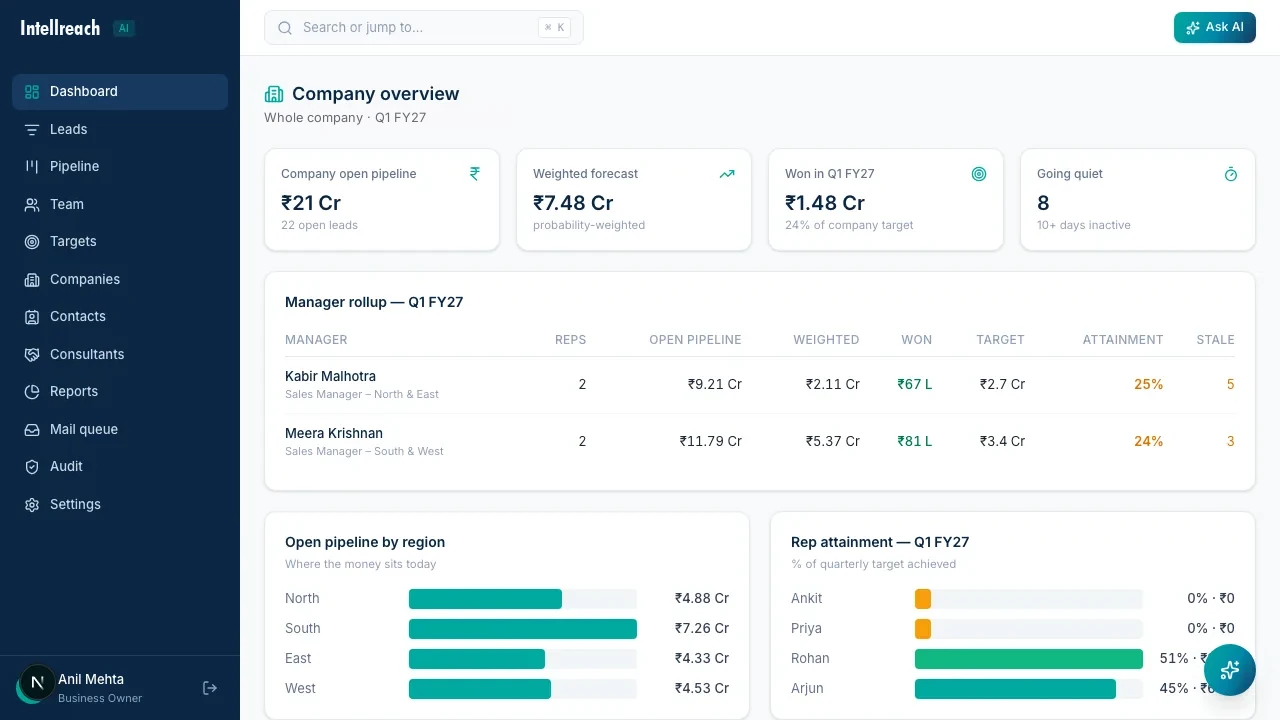
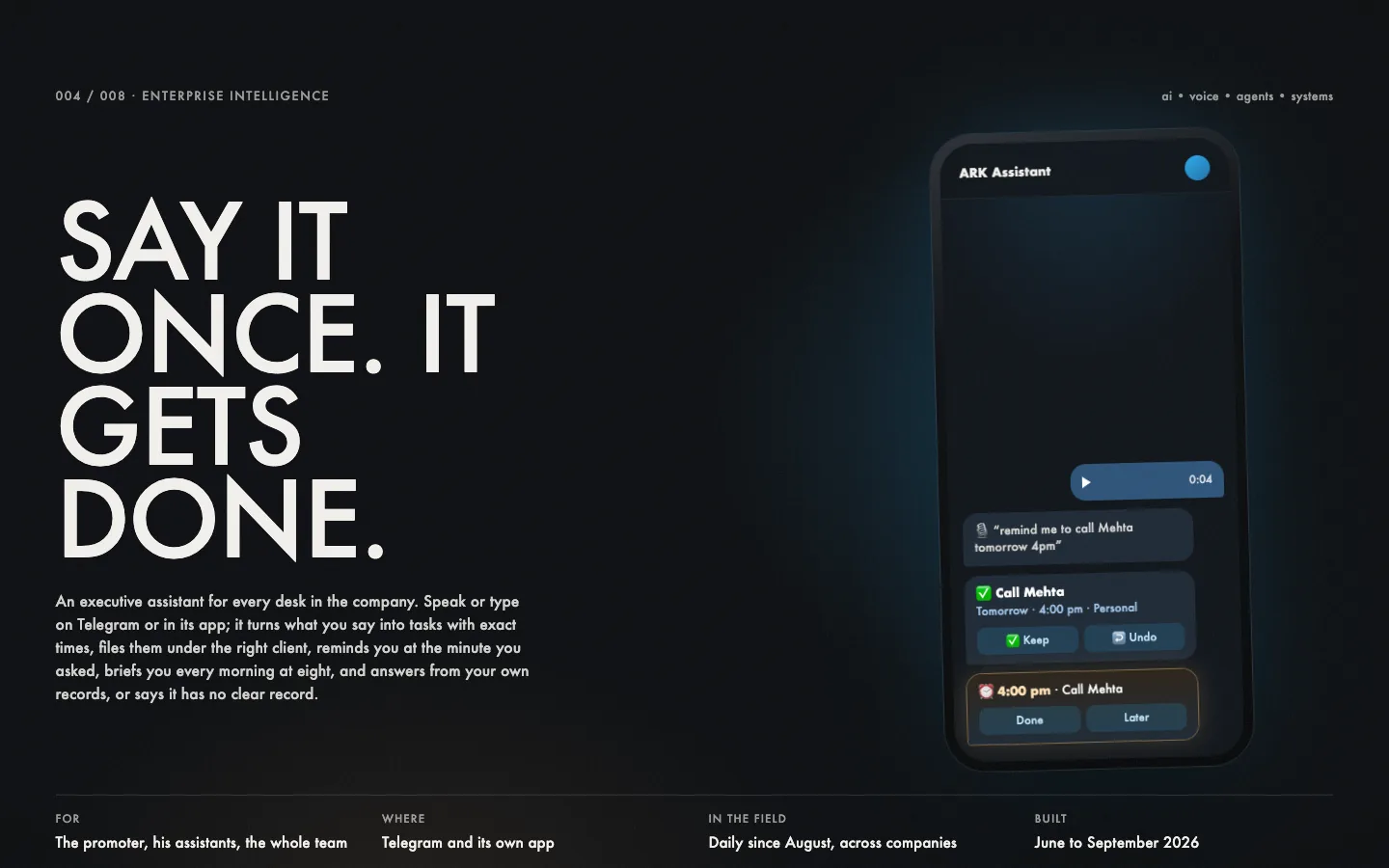
The two systems in our own work each close a leak of exactly this kind, and both are live. Intellreach closes the gap where enquiries came in through seven doors; ARK Assistant closes the one where a reminder lived in one person's head. Both are products now, for any company with the same leak.

  1. The gap

    Enquiries coming in through seven doors.

    The system · Intellreach

    One record for every deal.

    Every enquiry from seven channels lands in one pipeline; the AI briefs each deal and drafts each reply, and code computes every number. In production since September 2026.

    Read how it was built: Intellreach
  2. The gap

    The reminder that lived in one person's head.

    The system · ARK Assistant

    Said once. Reminded at the minute.

    A leader says it once, on Telegram or in its app; it becomes a task with an exact time, and a clock with no AI in it reminds at the minute asked.

    Read how it was built: ARK Assistant

Gap analysis or readiness

Gap analysis or AI readiness assessment?

They answer the same question and end differently. An AI readiness assessment scores how mature your data, infrastructure and governance are. Our gap analysis starts from the work itself and ends in the specific systems that would change it, so the first build can start from the list the analysis ends in.

An AI readiness assessment

How ready your data, your infrastructure and your governance are for AI, measured against a model. It tells you how ready you are. It does not tell you what to build first.

An ARK gap analysis

Where the work leaks, what each leak costs, and the system that closes it, specified closely enough to start. If you need the score as well, the map gives it to you.

Questions

Questions buyers ask.

What is an enterprise gap analysis?
It is a map of how your company's work actually moves, from the first enquiry to the quote, the order and the delivery, drawn from the people who do it, and a list of where that work leaks: the enquiry nobody answered, the figure typed three times, the follow-up nobody owned. Against each leak we name what would close it, AI, an automation or software, and in what order the returns come.
How long does it take, and what do we get?
The brief fixes how long it takes before we start. You get the map of the flow as it is, the gaps ranked by what they cost you, and for each one the system that would close it, specified closely enough to build. The analysis ends in a build list, not a slide about maturity.
Is this an AI readiness assessment?
It answers the same question and ends differently. A readiness assessment scores how mature your data, infrastructure and governance are. Our analysis starts from the work itself and ends in the specific systems that would change it, so the first build can start from the list the analysis ends in. If you need the score as well, the map gives it to you.
What does an analysis like this end in?
A build list: every gap ranked, and the system that closes each one specified closely enough to start. The systems are of the kind in our own work. Intellreach puts every enquiry from seven channels into one record and briefs each deal; ARK Assistant turns what a leader says once into a task with an exact time, and reminds at the minute asked.

The same flow, every gap closed.

Let's talk

Next · 07 / 09 · Be built around

The AI proposes. Your people decide.

Keep scrolling
to the next service